UTIMEA – Modular and Extensible Software Ecosystem (WIP)
The Project
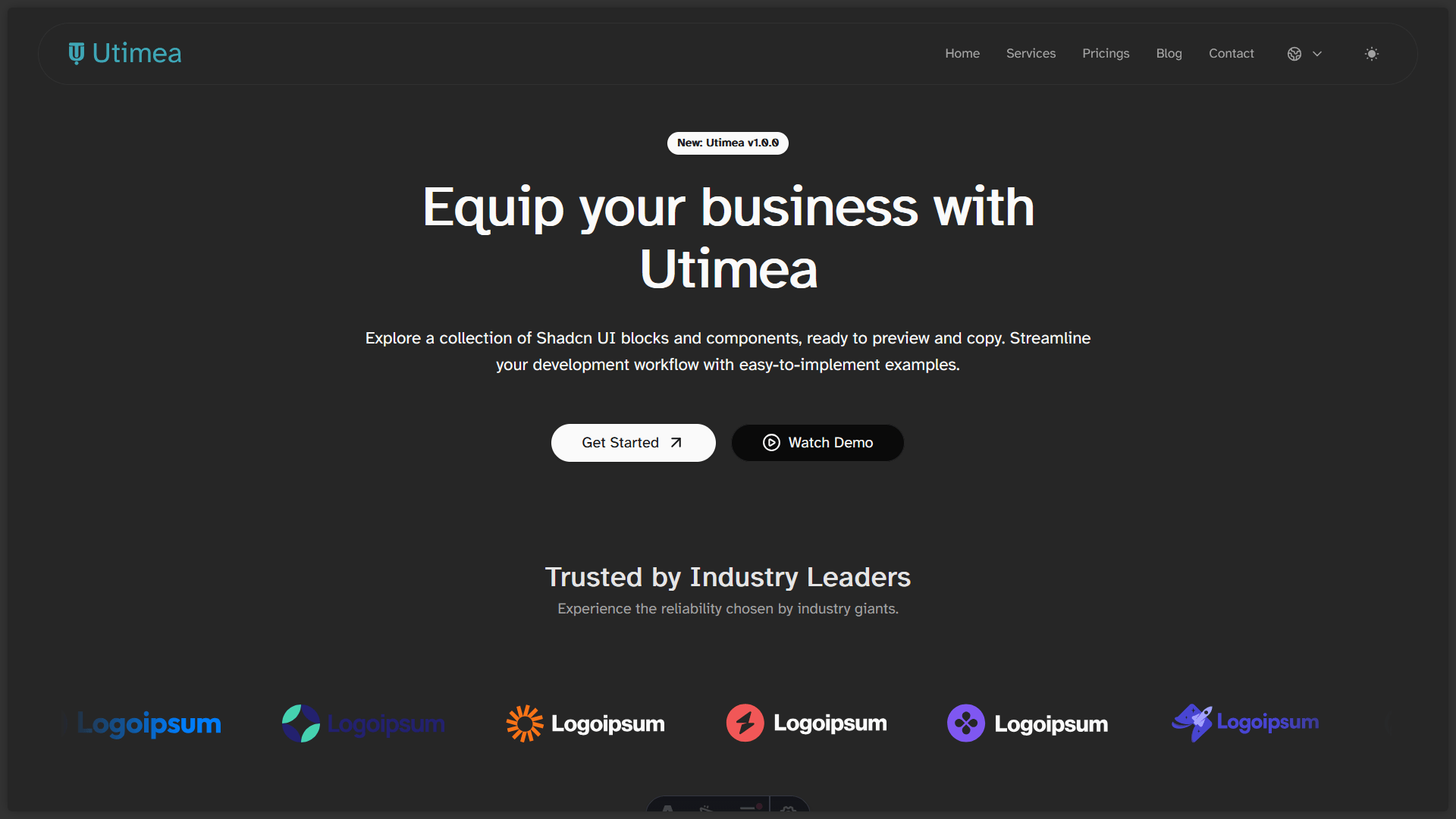
UTIMEA is a modular software ecosystem designed to serve as a universal application foundation on which independent business modules can be dynamically grafted. The initial problem addressed by UTIMEA is the rigidity of traditional ERPs and SaaS platforms, where each new feature implies deep modifications to the application core, making maintenance expensive and evolution slow.
Target users are:
- software publishers,
- companies seeking a custom platform,
- third-party developers capable of creating and distributing plugins.
The business objective is to propose an extensible on-demand platform, where each client activates only the necessary functional bricks (invoicing, HR, CRM, document management, etc.), while guaranteeing a homogeneous user experience, strong security, and long-term scalability.
UTIMEA positions itself as an application framework, more than a simple application, with logic close to a “web operating system.”
Technical Stack & Tools
- Frontend Core: Vite with Vue 3 and TypeScript for a performant, modular, and composition-oriented base. Vite allows ultra-fast module loading and natural integration of remote ESM code.
- UI Architecture: Web Components as the main abstraction layer for UI, allowing interoperability between plugins developed in Vue, React, or Vanilla JS, while maintaining visual consistency.
- Design System: Proprietary design system exposed as Web Components (based on Vue Custom Elements and/or Lit), integrating CSS tokens (colors, typography, spacing) and common accessibility rules across the entire platform.
- State Management: Minimal centralized core state (auth, permissions, application context) with an extension system allowing plugins to declare their own stores without collision.
- Plugin System: Dynamic plugin loading via ES Modules, with an official SDK defining a strict contract (manifest, lifecycle hooks, permissions, routes, menus, widgets).
- Backend: Modular API (AdonisJS or equivalent Node.js) exposing standard endpoints for authentication, plugin management, billing, permissions, and business data.
- CLI & Tooling: UTIMEA CLI for plugin scaffolding, manifest validation, build, versioning, and publication to marketplace.
- Security & Permissions: Declarative permission system inspired by CASL, allowing plugins to define their access needs (scopes, actions, resources) validated by the core.
Key Features
- Central Application Foundation: Management of authentication, users, roles, organizations, and shared application context across all plugins.
- Dynamic Plugin System: Installation, activation, deactivation, and updates of plugins without core redeployment, with hot loading on frontend.
- Plugin Marketplace: Catalog allowing third-party developers to publish their extensions, with version, dependency, and compatibility management.
- Extensible Routing and Navigation: Plugins can declare their own routes, menus, and pages, automatically integrated into global UI.
- Unified UI: All plugins consume the same design system, guaranteeing a consistent user experience despite diverse authors.
- Multi-tenant & Multi-product: A single UTIMEA instance can host multiple products or clients, each with a distinct plugin set.
Technical Challenges & Solutions
- Multi-Framework Interoperability: Allowing plugins written in Vue, React, or Vanilla JS to coexist in the same application was a major challenge. The solution was to standardize the UI interface via Web Components, which serve as a universal contract. Each plugin compiles its components into Custom Elements, natively consumable by the browser, eliminating any dependency on the core framework.
- Plugin Isolation and Security: A plugin must never compromise the global system. UTIMEA imposes a logical sandbox via a strict SDK, a dedicated namespace, and declarative permissions validated at installation time. Plugins access only APIs explicitly exposed by the core.
- Large-Scale Visual Consistency: With plugins developed by different teams, the risk of UI fragmentation was high. The design system, exposed as Web Components styled via global CSS tokens, guarantees visual uniformity while allowing controlled customization margin.
- Evolution Without Breaking Changes: The UTIMEA core must evolve without breaking existing plugins. This led to establishing strict SDK versioning, backward-compatible contracts, and automatic validation tools when publishing a plugin.
- Organizational Scalability: UTIMEA is not just a technical challenge but also an organizational one. The modular architecture allows multiple teams to work in parallel on independent plugins, reducing conflicts and accelerating time-to-market.
UTIMEA embodies a long-term vision: that of an open, extensible, and sustainable software ecosystem, where the core remains stable while innovation happens at the periphery, at the pace of business needs and developer community.